
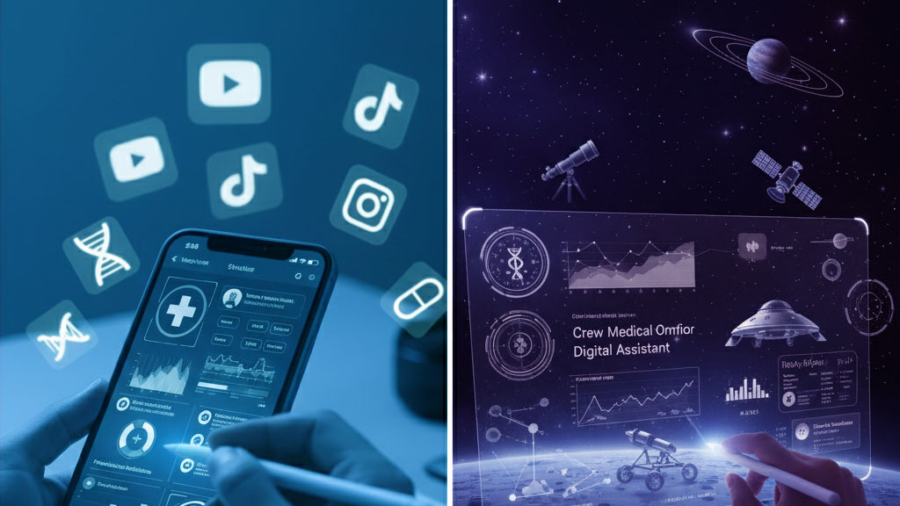
The rapid evolution of Artificial Intelligence is not just reshaping our daily lives; it’s actively transforming fields as diverse as medical science and space exploration. Far from being a futuristic dream, AI is already an indispensable tool, accelerating discoveries and pushing the boundaries of what’s possible for humanity, both within our bodies and across the vastness of the universe.
AI in Medical Science : A New Era of Healthcare
The impact of AI on healthcare is profound and ever-expanding. From diagnosis to drug discovery, AI is proving to be a game-changer:
- Accelerating Diagnosis: AI algorithms can analyze medical images (X-rays, MRIs, CT scans) with incredible speed and accuracy, often detecting subtle anomalies that might be missed by the human eye. This leads to earlier and more precise diagnoses for conditions like cancer, retinal diseases, and neurological disorders.
- Personalized Treatment Plans: By crunching vast datasets of patient information, genetic profiles, and treatment outcomes, AI can help doctors craft highly personalized treatment plans. This moves us closer to precision medicine, where therapies are tailored to an individual’s unique biological makeup.
- Drug Discovery and Development: The traditional process of bringing a new drug to market is lengthy and expensive. AI is streamlining this by identifying potential drug candidates, predicting their efficacy and toxicity, and optimizing molecular structures, drastically cutting down research time and costs.
- Robotics in Surgery: AI-powered robots assist surgeons with unparalleled precision, reducing invasiveness, improving patient recovery times, and enabling more complex procedures.
- Predictive Analytics: AI can predict disease outbreaks, identify patients at high risk for certain conditions, and optimize hospital resource allocation, improving public health management and operational efficiency.
AI in Space Science : Unlocking Cosmic Secrets
Beyond Earth, AI is an essential partner in humanity’s quest to understand the cosmos. The sheer volume and complexity of data generated by telescopes and probes are perfect playgrounds for AI:
- Exoplanet Discovery and Characterization: AI sifts through enormous amounts of astronomical data to identify potential exoplanets and analyze their atmospheres for signs of habitability, helping us find worlds beyond our own.
- Autonomous Spacecraft Navigation: For missions to distant planets or deep space, real-time human control is impossible. AI enables spacecraft to make autonomous decisions, navigate treacherous terrains, and adapt to unforeseen challenges without human intervention, ensuring mission success.
- Processing Astronomical Data: Telescopes like the Hubble and James Webb generate terabytes of data daily. AI algorithms are crucial for filtering noise, identifying patterns, classifying celestial objects, and even generating stunning images from raw data.
- Optimizing Rover Operations: On Mars, AI helps rovers like Perseverance choose optimal paths, identify interesting geological features for study, and manage their power consumption, maximizing scientific output.
- Predicting Space Weather: AI models analyze solar activity to predict space weather events (solar flares, coronal mass ejections) that can disrupt satellites, power grids, and pose risks to astronauts, allowing for timely protective measures.
The Symbiotic Future
In both medicine and space, AI doesn’t replace human ingenuity but augments it. It frees scientists and doctors from repetitive tasks, allows them to process information at scales previously unimaginable, and provides insights that propel discovery forward. As AI continues to advance, its role in improving human health and unraveling the mysteries of the universe will only grow, promising a future where the impossible becomes routine.
What are your thoughts on AI’s role in these critical fields? Share in the comments below!